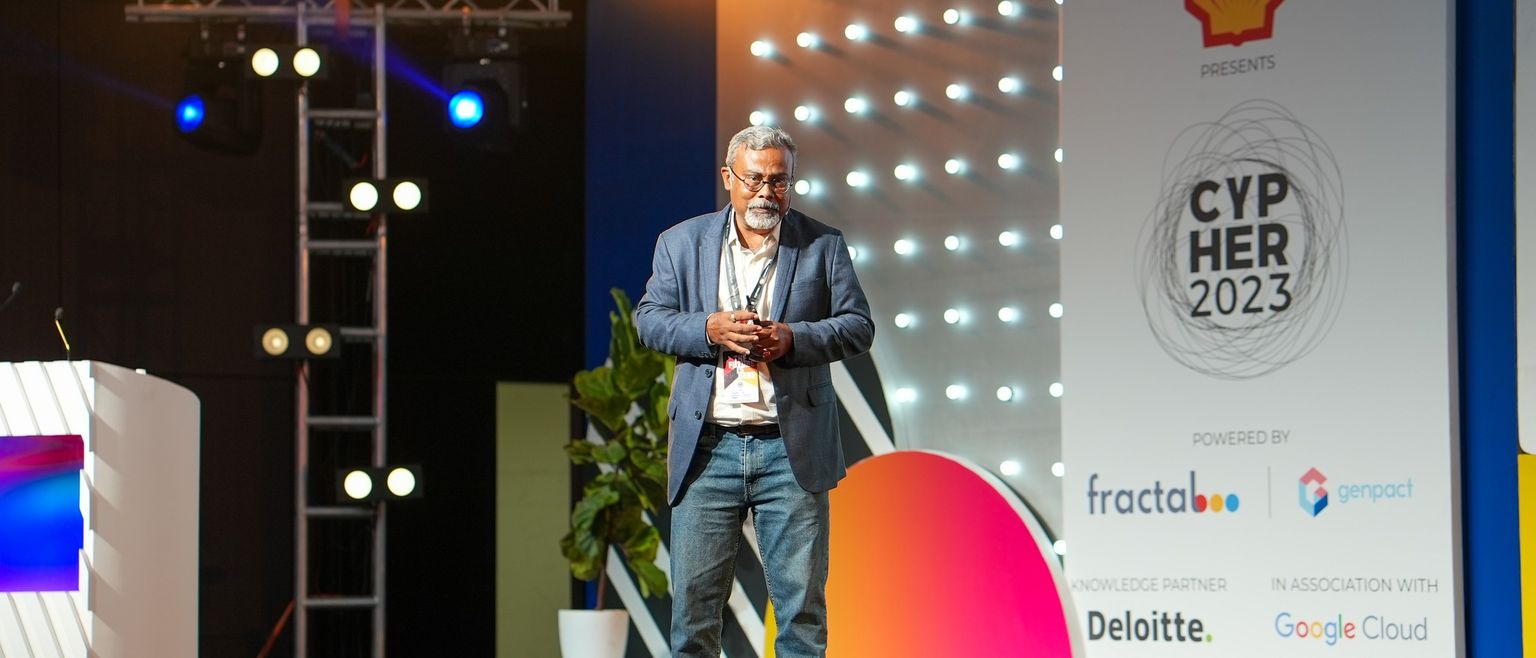
A sponsor wall is a confessional document. It tells you what a market valued enough to pay for visibility on. It tells you who could afford to be there. It tells you which companies were in growth phase, which were in defensive marketing posture, and which had quietly disappeared by the time the next edition rolled around.
Read across ten years of Cypher, the wall tells the story of the Indian AI industry better than almost any other artifact. Companies that look permanent on a 2017 sponsor list are gone. Companies that did not exist in 2017 now anchor 2025’s platinum tier. The mix has shifted from edtech and analytics services to cloud and foundation models. The geography has shifted from purely Indian companies to a globalised mix. And the value of being on the wall has shifted from awareness to access — from “we want to be known” to “we want to meet the people who buy.”

Here is what a public-record reading of the wall reveals.
The Analytics Era (2017–2019): edtech and services dominate
The first three reconstructable editions of Cypher were dominated by two categories: analytics training providers and analytics services firms. The 2017 sponsor list is led by Jigsaw Academy and Deloitte as platinum partners, with Great Learning, Manipal Global, and Wipro at gold. The silver and exhibit tiers are populated by IIDT, Insofe, Praxis Business School, Edvancer, Rinalytics, and Cognizant — a mix of training programs and consulting firms.
The 2018 wall doubled down on the same pattern. IBM, ZS Associates, and AnalytixLabs took the gold tier. Bridgei2i, Insofe, Manipal Prolearn, and SAP filled silver. The Weather Company (then under IBM), Wiley, and Praxis returned. Imarticus Learning sponsored the all-hands dinner. Actify Data Labs was the panel sponsor.
By 2019, the wall had matured into its first “powered by” structure. Genpact became the title sponsor — the company that has remained closest to Cypher across its decade-long run. The silver tier expanded to include Aditya Birla Group, Course5 Intelligence, Crunch Metrics, Ericsson, Evalueserve, MIQ, and SAP. Google Cloud sponsored the dinner. AWS appeared in the exhibit tier. Tredence — now one of the most consistent multi-edition sponsors — appears for the first time as an exhibit sponsor.
What the analytics era reveals is a market structured around skill development and consulting, not product. The sponsors selling to attendees were either training them to do the work or selling them the consulting that did the work. Product-led infrastructure plays were rare. Foundation-model players were non-existent because the category did not yet exist.

Figure 2: Sponsor category mix across the four editorial eras. Edtech and services dominated the analytics era; cloud infrastructure and foundation models now lead.
The Production ML era (2022–2023): the hyperscalers arrive
Cypher’s post-pandemic return in 2022 brought a new title sponsor — Fractal Analytics — and a sponsor mix that signaled the shift. Forty-plus organisations participated. Past-sponsor language in AIM’s 2022 announcements began to include Google Cloud, AWS, IBM, Deloitte, SAP, Cognizant, Ericsson, Tableau, Aditya Birla Group, Wipro, Genpact, ZS Associates, The Weather Company, UnitedHealth Group, and MiQ.
The 2023 wall was the broadest yet. The reconstructable speaker-affiliated companies span Shell, Hindalco, Deloitte, Tredence, Adani AI Labs, Zee Entertainment, Portea, EXL, Elsevier, Microsoft, Roche, Asana, Yellow.ai, Gupshup, Walmart, AstraZeneca, Birla Carbon, L&T Construction, ISRO, ANAROCK, Cargill, Cigna, Continental Automotive, Marvell Technology, Morningstar, Delta Capita, Bayer, Deutsche Bank, Synechron, MathWorks, Kellanova, Myntra, Broadridge, Alstom, Swiss Re, Reinsurance Group, Perfios, Presto, Singapore-based providers, and others.
Three patterns emerge. First, the edtech tier has thinned dramatically — the dominant training-provider category of 2017–2018 has been displaced by infrastructure and software. Second, the geography has globalised — Deutsche Bank, Cigna, Roche, Marvell, and others reflect the international captive footprint in India. Third, the categories have specialised — vector databases, model observability, vertical-AI platforms, and developer tooling all begin to appear as distinct sponsor segments.
The GenAI and Agentic era (2024–2025): cloud and foundation models take over
The 2024 wall introduced new patterns again. Synechron sponsored as gold. NVIDIA partnered with Tech Mahindra on Project Indus 2. NxtGen Cloud Technologies emerged as a major sponsor with Sunil Gupta’s Shakti Cloud reveal. Snowflake, Couchbase, Intel, Asana, Google Cloud, Cisco, and SAP all participated. Hanooman AI from Vishnu Vardhan made its debut. Sarvam AI through Vivek Raghavan appeared. American Express, Sberbank, and Akasa Air were among the global participants.
The 2025 wall, fully disclosed in AIM’s official announcement, is the most structurally revealing of all. NxtGen Cloud Technologies took the presenting partner slot — the most prominent position on the wall, formerly held by Fractal in 2022. Genpact returned as the powered-by sponsor — marking nearly seven years of recurring presence at the highest tier. The platinum tier consisted of Cisco, LinkedIn, Tredence, and ElevenLabs. The gold tier was AXA, EPAM Systems, Uber AI Solutions, and Tiger Analytics. Neysa took an AI Cloud Partner slot as its own category. Silver included Epsilon India and Lowe’s India. Exhibit sponsors were Alstom, Burns & McDonnell India, Carrier, Emalpha AI, KrtrimaIQ, NavAI, New Relic, ORMAE, Psyber Nova, Walmart Global Tech, and Firebolt.
Read against the 2017 wall, the 2025 sponsor mix represents an almost complete category turnover. Of the 2017 platinum sponsors, neither Jigsaw Academy (now acquired) nor Deloitte’s analytics practice appears in 2025 with the same prominence. Of the 2017 silver and exhibit tiers, only AnalytixLabs persists — every other company has been acquired, restructured, or quietly receded from the Cypher stage.

Figure 3: A survivor’s map of 36 named Cypher sponsors from public records, 2017–2025. Border colour indicates each company’s current status. *Great Learning was acquired by BYJU’s in 2021; the parent has since collapsed.
The patterns that emerge
Read across the survivor’s map, four patterns are unmistakable.
One: most early sponsors are no longer in their original form. Of the 16 sponsors traceable to 2017–2018, six have been acquired (Bridgei2i, Great Learning, Jigsaw Academy, The Weather Company, Insofe, Tableau — acquired by Salesforce shortly after appearing at Cypher 2019). One has been restructured (Manthan). One — Great Learning, acquired by BYJU’s in 2021 — had its parent collapse spectacularly. Only AnalytixLabs, IBM, Wipro, Deloitte, Cognizant, ZS Associates, SAP, and Course5 Intelligence have continued in essentially their original form. The Indian AI services and edtech market consolidated more than its participants realised at the time.
Two: the global hyperscalers and platforms have entered and stayed. AWS, Google Cloud, Microsoft, IBM, SAP, Snowflake, Cisco, LinkedIn, NVIDIA, and Intel have all appeared on Cypher walls. None has withdrawn. The hyperscaler footprint has only deepened — from peripheral exhibit sponsors in 2019 to platinum and powered-by tiers in 2024–2025. This is the clearest single signal that India has become a serious enterprise AI market.
Three: a new category of Indian AI infrastructure has emerged at the top of the wall. NxtGen Cloud Technologies (presenting sponsor 2025), Yotta’s Shakti Cloud (2024 prominence), and Neysa (AI Cloud Partner 2025) represent an Indian sovereign AI infrastructure category that did not exist on Cypher walls until 2024. The category’s prominence is itself a statement — about Indian capital, Indian GPUs, and the country’s appetite for not depending on global hyperscalers alone.
Four: the foundation-model and agentic-platform category has just begun to appear. ElevenLabs at platinum in 2025 marks the arrival of a globally-relevant foundation-model company on the Cypher wall. Hanooman AI (2024), Sarvam AI (2024), BharatGen (2025 session, not yet a sponsor) represent the Indian side of the same category. This is the wall’s newest category and its fastest-growing. By 2027, the foundation-model and agentic-platform tier is likely to represent the largest single share of the sponsor mix.
What it costs to read the wall this way
A reading of the sponsor wall is honest only if it acknowledges the bias built into its source data. Sponsors who got media coverage of their participation are over-represented in this reconstruction; smaller exhibit-tier sponsors who came and went without press are under-represented. Companies that have had recent acquisition news show up as “acquired” even when the post-acquisition entity continues to operate. Companies in quieter transitions are classified more cautiously.
The full picture — 200+ sponsors across all editions, with internal financial and engagement data layered on — lives inside AIM. This reconstruction is what the public record can tell. It is enough to see the shape, the shifts, and the survivors. A future, AIM-led version with internal data would convert this from analysis into the definitive document.
The 2026 question
The Cypher 2026 sponsor wall, when it is finalised in October, will be the most consequential reading of all. The category trajectory of the past three editions suggests three predictions:
First, NxtGen Cloud Technologies or a comparable Indian sovereign cloud player will continue at the presenting tier. The Indian GPU and sovereign infrastructure category is now structurally large enough to anchor the wall.
Second, at least two global foundation-model companies will appear at platinum. ElevenLabs’ 2025 platinum slot is unlikely to be a one-off. OpenAI, Anthropic, or a comparable lab — directly or through their Indian partners — will likely take a prominent slot.
Third, the agentic platform category, which appeared at session-level in 2025, will appear at sponsor-level in 2026. The companies enabling enterprise agents have just enough revenue maturity in 2026 to begin sponsoring conferences at scale.
The wall will tell us if those predictions are right. A decade after the first Cypher sponsor list of 20 companies dominated by edtech and consulting, the 2026 wall will be the most globalised, most infrastructure-heavy, and most foundation-model-aligned in the conference’s history. The sponsor wall has always been an honest document. The 2026 version will be the most honest yet about where Indian AI actually is — and where it is going.